57 Self Care Ideas for a Bad Mental Health Day
Black and white print of ladies face

57 Self Care Ideas for a Bad Mental Health Day

Key Takeaways

  • Self-care on a bad mental health day doesn't have to be complicated: small, sensory actions like a warm shower, music, or a walk outside can genuinely shift how you feel.
  • Having a go-to self-care list matters: when you're in a dark place, decision-making is hard. A ready-made list of self-care tips for mental health means you don't have to think, just act.
  • What works is deeply personal: this list of 57 self-care ideas comes from real people with lived experience of tough mental health days, so you can find what resonates with you.

When everything feels difficult, self-care can be a survival skill

It can be difficult to practice self-care during the moments we need it most. On bad mental health days, when everything feels heavy, when panic sets in, when nothing feels OK, it's easy to completely forget how to take care of yourself.

It's tempting to fight against it, or try to "will" the bad feelings away. And then just as tempting to beat yourself up when sheer willpower isn't enough.

That's when it's time to pause, take a breath, and be kind to yourself. Self-care is a practice, not a performance. Knowing what to do on a bad mental health day before it arrives, and having a list of self-care ideas you can reach for, can make all the difference when life gets tough.

To get ideas from people who've been there, the team at The Mighty asked their mental health community to share their self-care tips for mental health. We've gathered their 57 ideas below, grouped by theme to make it easier to find what might work for you right now.

You deserve to give yourself some love during these dark moments, just like you would a friend. Doing so isn't selfish, it's survival.

Mind and body: simple physical acts that help

Sometimes the most powerful self-care activities for mental health are the most basic. When you're having a bad mental health day, your body and mind are deeply connected, and small physical acts can send a powerful signal that you're worth caring for.

Even minor physical rituals, like showering, stretching, getting dressed, can help interrupt a depressive episode by creating a sense of agency and forward momentum. You don't have to do everything. You just have to do one thing.

"Shower. It's so basic, but if you're going through a really bad rough patch you can forget about it completely. When you get out, you feel fresh and beautiful again, which is a huge boost to me." — Nina F.
"Go out for a walk. Take a bath. Have some tea." — Sandi C.
"A nice nap under a warm blanket with music in the background." — Julissa R.
"During a depression episode, trying to brush my teeth even if I plan on staying in bed all day. It's small, but I find it helps motivate me even if it's just to stay up a few extra hours a day." — Cori A.
"Get moving. Stay strong — as always it will pass. Remember you're pretty good at this. Or if all else fails, have a nap, sleep it off and repeat." — Jodie H.
"Sometimes just saying 'enough' and going to bed early. Letting myself rest when I'm trying to constantly push through." — Kalie E.
"The one I use the most is slowing down, caressing my own hands, breathing deeply and probably stretching my muscles if I can at the time, all of this is even better if I'm barefoot. It's all about releasing myself of the pressures and reminding myself how worthy I am." — Luah L.
"As a makeup artist, I find skincare can be not only beneficial for my skin, but it also helps make me slow down and not self-deprecate constantly. I always feel a little happier afterwards!" — Nova M.
"A face mask! I particularly love a peel-off honey one. I feel super relaxed afterwards and it makes me feel like I've peeled the bad day away." — Adele M.

Water and warmth: the healing power of a bath or shower

A surprising number of people reach for water as one of their go-to self-care ideas for anxiety and low moods, and there's solid reasoning behind it. Warm water activates the parasympathetic nervous system, which helps calm the body's stress response. The sensory immersion of a bath or shower also pulls attention into the present moment, which is a core principle of mindfulness for mental health.

Whether it's a long soak with candles, a cold shower to shock the system awake, or simply watching waves at the beach, water has a way of resetting the body when the mind won't cooperate.

"I like taking a long hot bath and reading. It is literally the most relaxing thing ever." — Jessica C.
"A bath! Water is so healing to me. Submerging myself for however long I need. I can read, listen to music or just sit on my phone. Just sitting in warm water with candles and pleasant scents can calm me so much." — Alyse R.
"I take a bath with a glitter bath bomb and I suddenly focus on all the glitter around me and begin to relax." — Kimy B.
"Eating ice cream while in a warm bath." — Erica M.
"I get in my car and drive down to the beach, put on my music and watch the waves. So relaxing." — Renee C.

Music, singing, and dancing

Music is one of the most widely cited self-care tips for mental health, and one of the most evidence-backed. Listening to music activates the brain's reward system, triggering dopamine release even during low moods. It can also act as an emotional mirror, helping you feel seen and less alone when words fail.

Whether you're putting on a playlist that matches your mood, belting out a favourite song in the car, or moving your body to a beat, music gives feelings somewhere to go. It's one of the most accessible self-care ideas at home, requiring nothing but a phone and a speaker.

"Music, instantly. I think a few genres of songs really are helpful. Days like this happen a lot, and knowing the turn-out, it's different for me. Music helps me think straight, and lyrics help too." — Hunter P.
"I listen to my favourite 'calm down' song, 'Details in the Fabric' by Jason Mraz, and pray." — Nova T.
"Sing; put on a good classic CD and sing my heart out. (Maybe have a boogie while I'm at it.) Works at home and in the car." — Sara C.
"I dance to music. It takes my mind off things for a while. I forget all my thoughts and just listen carefully to the lyrics and express myself." — Lily B.
"Playing piano. It helps me relax, release my feelings and feels like I'm doing something well. The piano has been and always will be one of my best friends, because it's always there, never judging my ability and helping me become better at what I love." — Jacinta M.
"I blast my favourite music to shut out the world, and then I paint, draw or write. Sometimes all three." — Moon N.

Creative outlets: art, writing, and making things

Creativity is a powerful tool in any mental health self-care routine. When emotions are too big or too tangled for words, making something, such as drawing, painting, journaling, colouring, gives them a form that can be held, seen, and set aside.

Art-based therapies are widely used in clinical mental health settings precisely because they offer a non-verbal pathway through difficult emotions. But you don't need to be an artist for this to work. The act of making, not the quality of the output, is what matters.

"Art is my best way of escaping from suicidal thoughts. I'm not a professional artist, but you can get really good stuff as you're releasing your pain into a piece of art. It really works for me." — Bell G.
"Colouring in mandalas. They've helped me get through some of the toughest times with anxiety, PTSD, an eating disorder and a chronic illness. There's something so soothing about the repetitive patterns." — Cate M.
"My go-to self-care is anything that keeps my hands busy and mind distracted. My main two are water painting and origami. They calm me down so much." — Lily G.
"Bullet journaling and a comforting favourite TV show." — Kae-jo W.
"Journaling. Listening to music. Going for a walk or to the gym." — James T.
"Write. Always write whatever comes to mind. And if nothing comes to mind, just write anything that makes no sense. It helps calm your mind." — Mishal S.
"Writing my goals, my strengths and what I'm grateful for. Having a relaxing bath. Putting in time to clean my room. Good music and sports." — Ruth D.
"Writing letters all around the world and watching a series at the same time. I absolutely love it and it works." — Mika M.
"I find painting rocks so relaxing and therapeutic. Then going on a walk and hiding the painted rocks around the city is exciting — and it's an extra buzz when people find them. Spreading smiles and positivity to others is my self-care." — Hla E.

TV, films, and comfort viewing

There is nothing wrong with comfort viewing. When the mind needs a rest, sometimes the kindest self-care tip is to switch off and let something familiar carry you for a while.

Familiar content, such as shows you've seen before, or films from childhood, is particularly soothing because it removes cognitive load. You know what's going to happen, which means your nervous system doesn't have to stay alert. It's a form of controlled predictability when everything else feels uncertain. Think of it as a legitimate coping strategy, not a waste of time.

"Lots of chocolate and Netflix in bed." — Zara M.
"I watch 'Friends' on repeat. I know it all by heart and it's comforting." — Iga Ż.
"I watch anything with Robin Williams. He always makes my day a bit better." — Meesh M.
"Watching 'Family Guy.'" — Brandon C.
"I have a few animated movies that always make me feel better. 'Tangled,' 'Brave' and 'Moana.' On a bad day I'll put on one of those and burrow under a blanket." — Michelle M.
"It may sound odd, but for me watching 'The Simpsons'; it's my go-to feel-good program that never fails to put a smile on my face." — Becki K.
"Lately it's been watching Disney movies or listening to Disney songs. They make me happy and remind me of times when life was easier." — Katie S.
"I try to utilise my senses, like mindfulness skills, and I try to watch something upbeat. I've probably seen every episode of 'Modern Family' multiple times." — Leigh A.

Nature and getting outside

Spending time in nature is one of the most well-researched self-care activities for depression and anxiety. Even a short walk outside can reduce cortisol levels, lower heart rate, and shift perspective. In Australia, where open spaces, parks, and coastlines are rarely far away, getting outside is one of the most accessible things to do on a bad mental health day.

You don't need a destination. Sometimes just changing the environment, and feeling sunlight, hearing birds, or smelling fresh air is enough to interrupt a downward spiral.

"I get in my car and drive down to the beach, put on my music and watch the waves. So relaxing." — Renee C.
"Getting out with my little boy. Even if it's just to the park, just doing something he enjoys. Seeing the smile on his face is all I need some days." — Georgia C.
"I leave the house or make sure I distract myself by keeping myself busy. I can't stay in or do nothing because I tend to overthink and it makes things way worse." — Anna C.
"Tea with honey and laughter. If I can go, I'll go to the beach behind my house and sit." — Lindsay G.

Pets, people and connection

One of the most important self-care tips for mental health is this: you don't have to cope alone. Connection with people, with pets, or even with a community online is a core human need, and isolation tends to deepen difficult mental health days rather than ease them.

Animals in particular offer a form of unconditional presence that can be deeply grounding. And doing something kind for others, even small acts, can create a sense of purpose and shift focus outward when turning inward isn't helping.

"Cuddle and kiss my dogs." — Auror B.
"I find that spending time with my cat is always a good form of self-care! Taking care of him gives me purpose and reminds me I am loved." — Caroline R.
"The thing that seems to help the most is doing something for someone else. Seeing them smile. Not much better feeling when you know you've made a difference." — Becka M.
"I go to my husband and he holds me tight and tells me it's gonna be OK." — Kimberly A.
"Just talk about it. Try to open up and let someone know what you are feeling. It really helps to just be heard." — Tammy F.
"Self-care for me is doing something I love. Or being with someone I love." — Janet B.

Books and escaping into another world

Reading is one of the oldest and most reliable self-care ideas at home, and for good reason. Immersing yourself in a story shifts your attention fully into another world, offering genuine mental rest from your own thoughts.

If concentration is hard (as it often is on a bad mental health day), audiobooks or short stories can be a gentler entry point than a novel.

"Books. If it's really bad; music and books. I just love reading, especially romance." — Samantha V.
"Reading books. It transports me to another world and helps me calm down and feel better about whatever is happening in real life." — Maycie W.
"Usually I read a book or scroll through Facebook for a while. It seems to take my mind off all the messiness in my head." — Leslee B.

Mindfulness and meditation

Mindfulness for mental health doesn't have to mean sitting cross-legged in silence. It simply means bringing your attention to the present moment by noticing what you can see, hear, smell, touch, or taste, instead of being pulled into anxious thoughts about the past or future.

Grounding techniques for a bad mental health day can be as simple as breathing slowly for a few minutes, placing your bare feet on the ground, or counting five things you can see around you. These techniques won't fix a hard day, but they can reduce the intensity of distress in the moment and help you feel more in control.

"Any guided meditation that I find the music and narrator's voice soothing." — Holly B.
"I try to utilise my senses, like mindfulness skills." — Leigh A.
"Turning my phone off!" — Valerie C.
"Taking my medicine daily and just taking it one day at a time, one hour at a time or just even one minute at a time." — Lee W.

Self-compassion and changing your perspective

Sometimes the most radical self-care tip for mental health is changing how you speak to yourself. On a bad mental health day, the inner critic tends to be loudest, and yet that's precisely when you most need the kindness you'd offer a close friend.

Self-compassion doesn't mean pretending things are fine. It means acknowledging that what you're going through is hard, that bad days are a normal part of being human, and that this feeling, like all feelings, will pass. A simple mental health self-care routine around self-talk can be one of the most powerful tools you build over time.

"Giving myself permission to self-validate that I'm having a bad day. And I remember that these moments came to pass and practise gratitude, because then my perspective loosens up." — Holli E.
"I try to accept my feelings and be understanding towards myself about why certain things are harder for me than for others. I say to myself: 'Look how far you've already come.'" — Atte M.
"I sit in my car or shower and cry. I think about the last time I felt that way, and how I felt like it wasn't going to end, but it did. And it will end again this time." — Ashlee B.
"I buy myself flowers. I love picking up the different bouquets and smelling them, and finding the brightest ones. They can really lighten up a room, and every time I look at them, I remember self-love." — Chelsea J.

Building your own self-care checklist for mental health

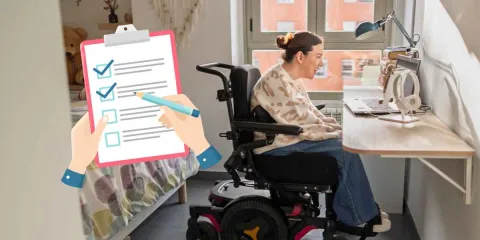
Reading through other people's ideas is a great starting point, but the most useful thing you can do is build your own self-care checklist for mental health that's ready before you need it.

Think about what has helped you in the past, across different categories: physical (movement, water, rest), sensory (music, scent, texture), social (a person to call, a pet to cuddle), creative (drawing, writing, making), and mental (a show to watch, a book to read, a breathing exercise).

Write it down somewhere accessible: your phone notes, a journal, even a sticky note on the fridge. On a bad mental health day, that list is something you can reach for without having to think.

Need more support?

If you're having a bad mental health day and need to talk to someone, please reach out. Mental health support in Australia is available 24/7.

  • Lifeline: 13 11 14 (24/7 crisis support)
  • Beyond Blue: 1300 22 4636
  • Headspace: headspace.com.au (for young people aged 12–25)

For NDIS participants: If you're looking for ongoing mental health support through the NDIS, MyCareSpace can help. Our free Connections Team is linked in with a range of therapists and mental health service providers across Australia with current availability. We'll help you navigate the NDIS and find the right support for you.

THERAPY FINDER - FREE SERVICE

Our Connections Team at MyCareSpace are linked in with a range of providers offering telehealth services with availability. Let our team help you navigate the NDIS and find the right service for you.
Get started with Therapy


LET US FIND YOU A SKILLED SUPPORT WORKER

Let our Expert Team find you the right support worker: one that has experience with your disability and that you can rely on. It's FREE service.
Find me a support worker


Share this resource

How helpful was this resource?
How helpful was this resource?: 

More like this

MyCareSpace resources may be shared provided they are credited to MyCareSpace with backlinks to the original resource.